by | Dec 21, 2017 | Others, Public Lecture, Staff, Students, Talk, UTM Calendar
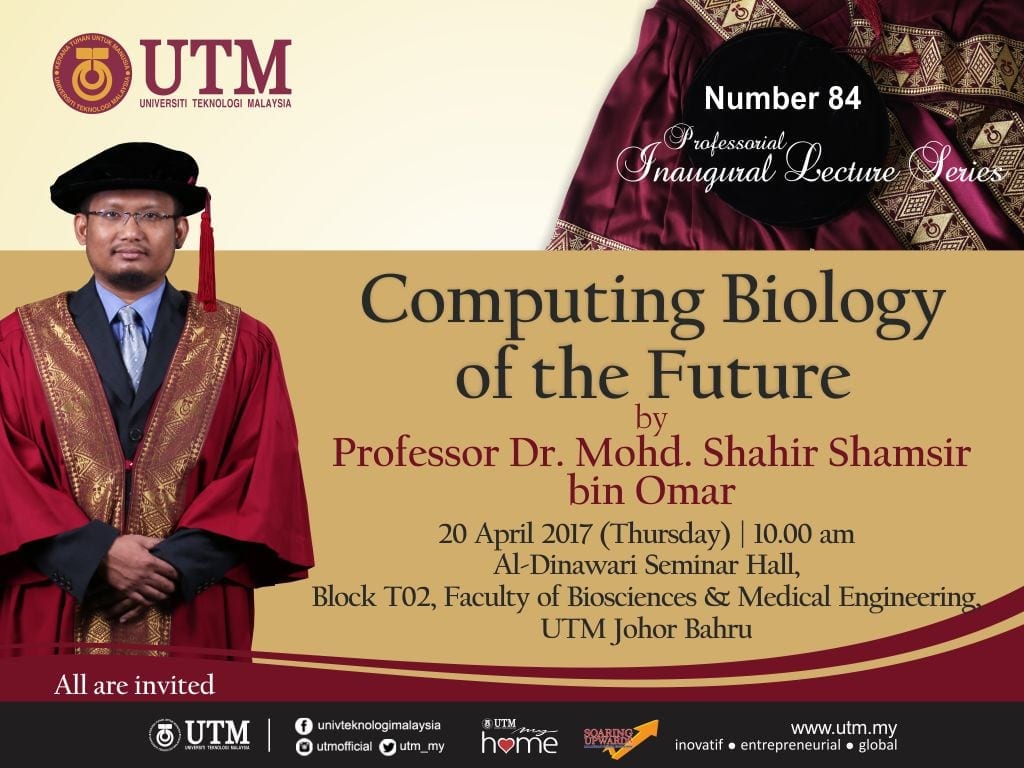
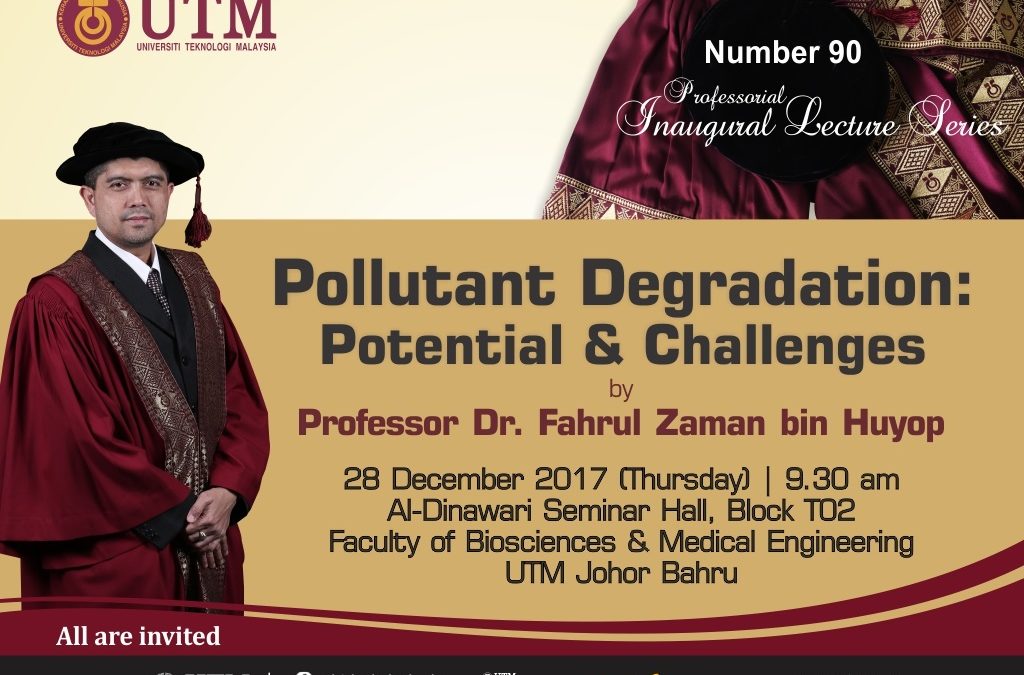
Pollutant Degradation : Potential & Challenges
Organic pollutants are mostly anthropogenic and microbial degradation plays an important role to reduce the build-up of toxic chemicals in the soil and water systems. Degradation of halogenated organic compounds are highlighted because carbon-halogen bonds are the most recalcitrant materials. There are four important criteria for a given halogenated compound to be utilized by an organism as a sole carbon and energy source. First, the halogenated compound should not be toxic to the organism at intracellular concentrations. Secondly, entry of halogenated compound into the organism should be either through passive or active transport and trigger a specialized genes in the operon. Thirdly, the organism should be able to synthesize enzyme (dehalogenase) which can remove the substituent halogen(s) from the compound and finally, the product of dehalogenation should be non-toxic and easily converted to an intermediate which can readily be absorbed in the microorganisms via central metabolic pathways. There were many dehalogenase producing bacteria were isolated so far. Among all these microbes, only Rhizobium sp. RC1 produce three kinds of dehalogenase DehD, DehE and DehL. Current study will focus on all of these 4 challenges criteria that has big potential to allow biodegradation to occur.
by | Dec 5, 2017 | Others, Staff, Students, Talk, UTM Calendar
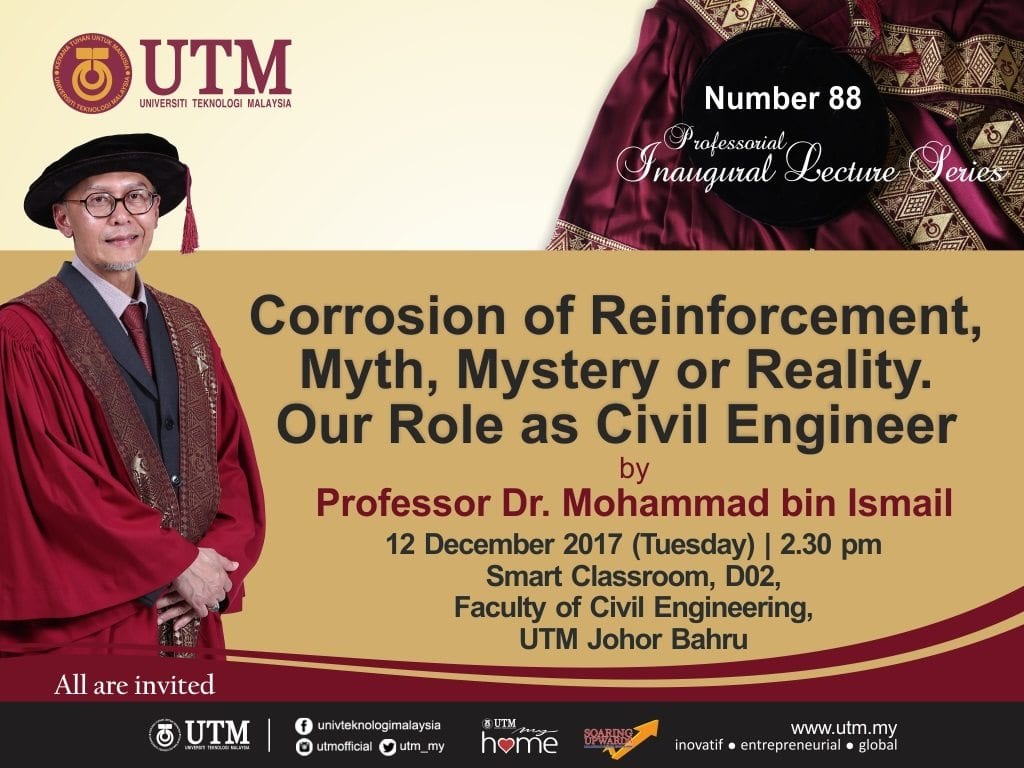
All staff and students are cordially invited to the 88th Professorial Inaugural Lecture Series by Professor Dr. Mohammad bin Ismail, Deputy Dean of Research, Innovation, Commercialization and Network from Faculty of Civil Engineering, UTM Johor Bahru on the respective date and time as below :-
Date : 12 December 2017 (Tuesday)
Time : 2.30 pm
Venue : Smart Classroom, Block D02, Faculty of Civil Engineering, UTM Johor Bahru
Title : Corrosion of Reinforcement, Myth, Mystery or Reality. Our Role as Civil Engineer.
by | Oct 9, 2017 | Academic, Kuala Lumpur, Others, Public Lecture, Staff, Students, Talk
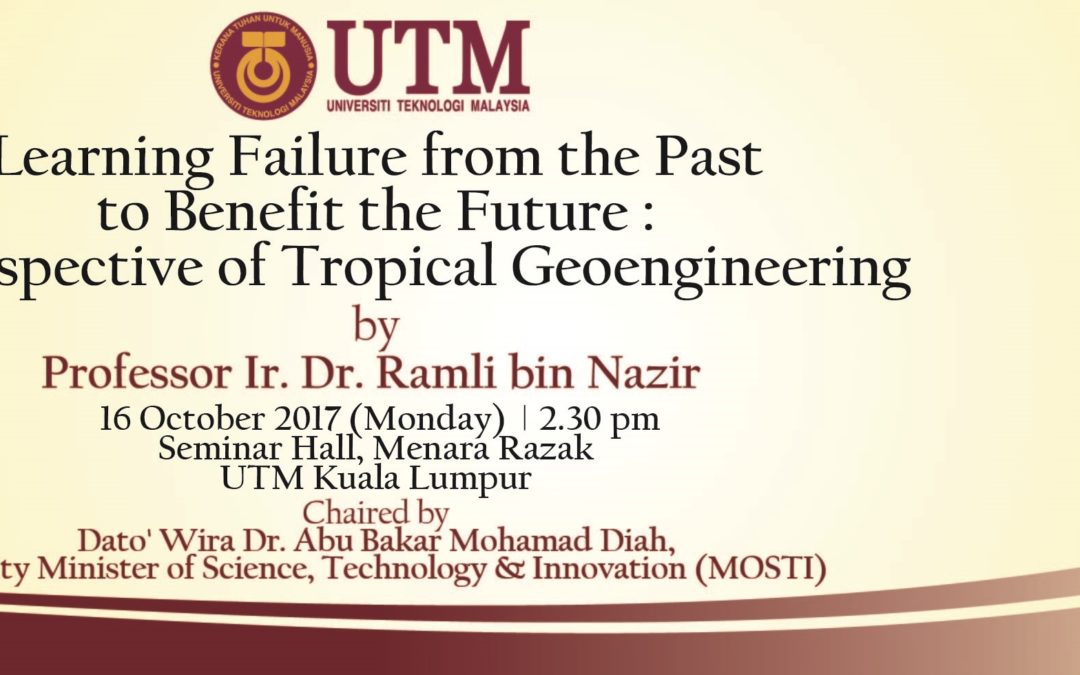
Learning Failure from the Past to Benefit the Future : In Perspective of Tropical Geoengineering
by | Mar 15, 2017 | Public Lecture, Students, UTM Calendar

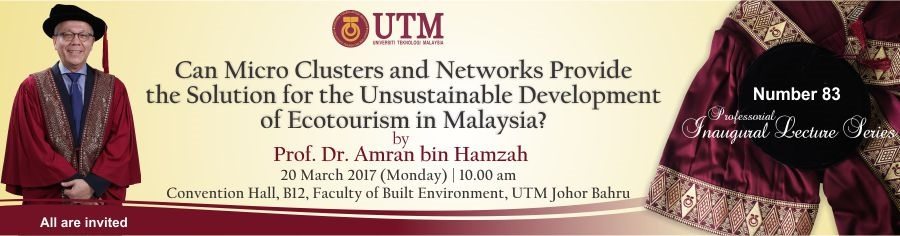
Ecotourism development usually takes place in rural and remote areas that lack accessibility and the supporting infrastructure to attract quality investors. While tourists are increasingly being attracted by the uniqueness of the ecotourism experience, the lack of critical mass is another major impediment against quality investments in ecotourism in Malaysia. Tourism planners have generally overlooked the potential use of micro clusters as a tool for the planning of ecotourism development in rural areas towards optimizing its economic sustainability. This professorial lecture will present the body of work that Prof. Amran Hamzah has accumulated as an academic practitioner that is specifically related to ecotourism planning and management. It will focus on the of use of horizontal and diagonal clustering in developing synergistic relationships between key stakeholders in ecotourism development so as to optimize its economic potential, which in turn, will facilitate the sustainable financing of conservation efforts aimed at preserving the natural and cultural ecotourism assets. Central to the micro cluster approach presented in this lecture is its application in the formulation of the National Ecotourism Plan 2016 to 2026, which is a testimony to the success in bridging the gap between theory and practice in ecotourism planning in Malaysia.